What should a business travel ground transportation RFP require beyond a vehicle and pickup time? Set clear expectations for service areas, airport and point-to-point transfers, itinerary changes, chauffeur conduct, passenger privacy, and the information your team needs to manage travel. For Minneapolis-Saint Paul trips, include MSP Airport, local offices, hotels, and meeting venues in your requirements.
A provider should make bookings straightforward, communicate clearly when plans change, and treat every passenger professionally. In this guide, we explain what to include in an RFP, how airport, hotel, office, and home transfers fit business itineraries, and which chauffeur and privacy standards matter. You’ll also learn how to assess coverage, traveler support, safety practices, and spending visibility before booking.
Key Takeaways
- Set RFP expectations for service coverage, booking support, itinerary changes, and the reporting your travel program needs.
- Plan transfers around flight details, pickup instructions, luggage, waiting time, and connections between travel stops.
- Include chauffeur conduct and passenger privacy in your service standards to support a professional, comfortable trip.
- Assess whether transportation options fit your travelers’ destinations, schedules, and trip requirements before booking.
Corporate ground transportation services
Corporate transportation programs coordinate rides around business itineraries, from airport transfers to meetings and events. An RFP can define service areas, booking channels, billing records, and the standards expected across destinations.
Consistent Service Across Reservations
Consistency means applying the same booking and service standards across travelers, trips, and reservations. For an executive assistant arranging airport transfers for several employees, clear pickup details and consistent billing make every trip easier to manage. A corporate program can also specify how reservations connect to itineraries, rather than treating each pickup as an isolated ride.
Worldwide coverage may rely on local affiliates. An RFP can list required destinations and service standards, including how reservations and billing should be coordinated across locations. For travel centered on Minneapolis-Saint Paul, specify local routes as well as any out-of-town destinations your team regularly uses.
Customized Business Travel Services
Customized transportation matches the ride to the traveler’s schedule, destination, and trip purpose. A rental car may suit a remote site visit or multiple stops, while a chauffeured vehicle can work well for an airport-to-meeting itinerary. Specify expected trip types, booking workflows, and billing details in the RFP so reservations align with company travel procedures.
Transportation Options and Cost Comparisons
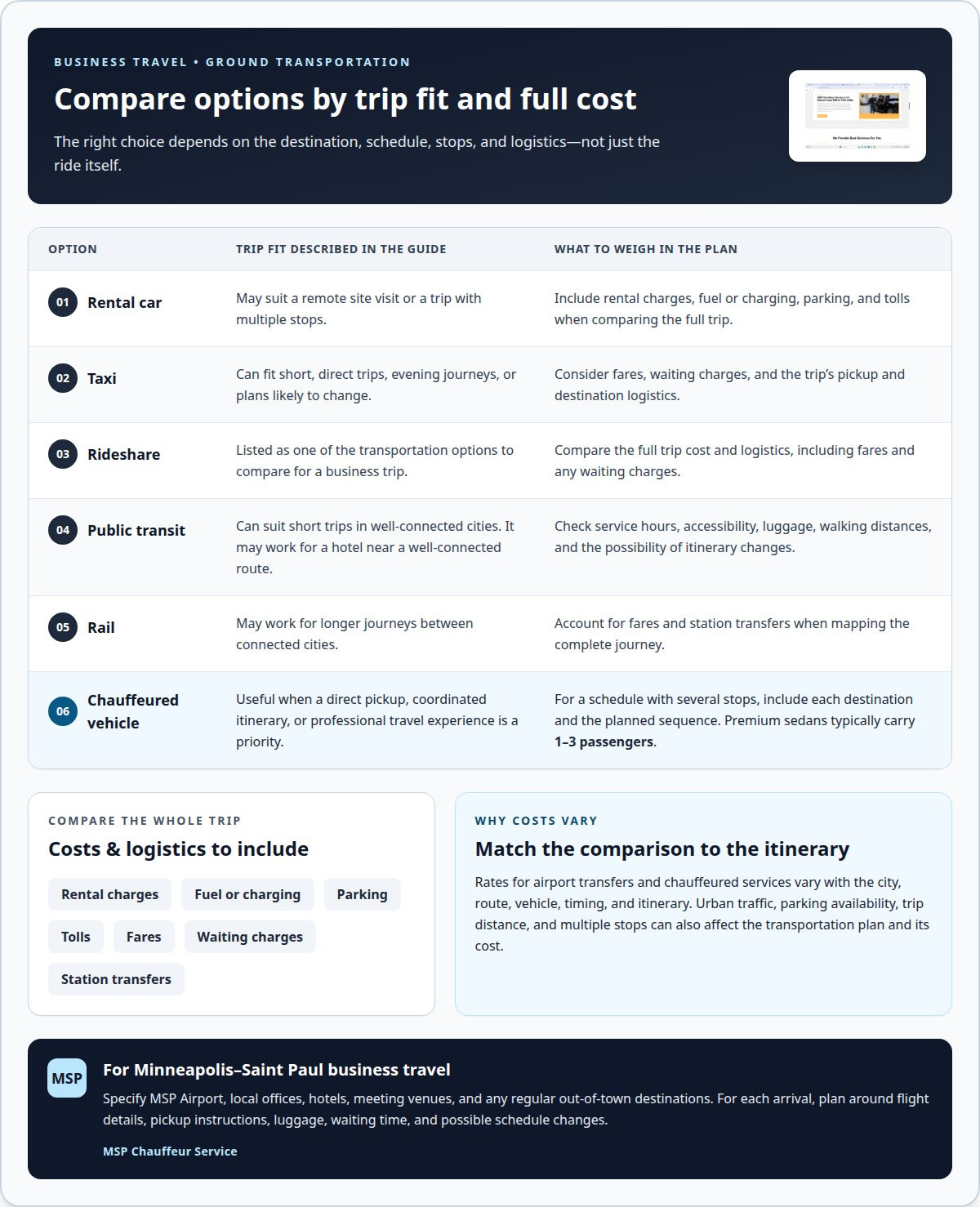
Options include rental cars, taxis, rideshares, public transit, rail, and chauffeured vehicles. Compare the full trip cost and logistics, including rental charges, fuel or charging, parking, tolls, fares, waiting charges, and station transfers. Public transit can suit short trips in well-connected cities; rail may work for longer journeys between connected cities. A chauffeured ride is useful when a direct pickup, coordinated itinerary, or professional travel experience is a priority.
Rates for airport transfers and chauffeured services vary with the city, route, vehicle, timing, and itinerary. Urban traffic, parking availability, trip distance, and whether the booking includes multiple stops all affect the transportation plan and its cost. For reimbursements, the employer’s travel policy determines what employees can claim. According to the Internal Revenue Service, travel between clients or customers and taxi fares between an airport or train station and a hotel or business location are deductible travel expenses.
Airport, train, hotel, office, and home transfers
A transfer plan connects each arrival point with the next business destination. For airport or train arrivals, account for pickup instructions, luggage, waiting time, and possible schedule changes.
Airport Transfers and Taxi Service
An airport transfer is a prearranged ride from the airport to a hotel, office, home, or event. It suits fixed arrivals, late flights, and groups because pickup details can be coordinated in advance. Taxis fit short, direct trips, evening journeys, or plans likely to change.
For a conference arrival, include the flight, pickup location, luggage needs, and onward destination in the itinerary. Also plan for waiting time and what happens if a flight is delayed. Public transport may work for a hotel near a well-connected route, but consider service hours, accessibility, luggage, walking distances, and the possibility of changes.
Executive Airport Transfers
Executive airport transfers are prearranged rides coordinated around a traveler’s flight and business itinerary. They can connect the airport with hotels, offices, conference venues, or off-site meetings. This coordination helps travel teams plan the journey beyond the terminal pickup.
For an executive traveling from an airport to a client meeting, the booking can connect flight details with pickup instructions and the meeting destination. Premium sedans typically carry 1-3 passengers, making them one option for individual travelers or small parties. For a schedule with several stops, include each destination and the planned sequence in the itinerary.
Hotel, office, and home transfers also need accurate addresses, pickup times, and destination details. A train passenger may need a station pickup followed by a hotel drop-off, while a conference attendee may travel between the hotel and venue. Including every leg helps prevent a gap between arrival and the next commitment.
For Minneapolis itineraries, local airport transfer planning can be part of arranging a trip between MSP Airport and a business destination. A complete plan connects the arrival point, traveler’s schedule, luggage, and final stop.
Chauffeur professionalism and passenger privacy
A corporate RFP should request applicable insurance documentation, vehicle maintenance practices, and written safety procedures. It should also set expectations for chauffeur conduct, incident communication, and passenger privacy. These details help an organization assess duty of care before arranging a ride to an airport, client meeting, or conference.
Professional discretion means treating passenger conversations, destinations, and schedules as private. A chauffeur taking an executive from a hotel to a client meeting, for example, should focus on the ride and not share trip details. An RFP can clarify expectations for respectful communication, personal information, and handling itinerary details.
Chauffeured business travel can give passengers time to prepare for a meeting or work during a direct transfer. A reserved car also removes the need to drive, find parking, or navigate an unfamiliar route. For a day with a hotel pickup and several business stops, itinerary coordination helps connect each ride to the next commitment.
Training and compliance standards should be described plainly in the provider’s response. Ask for details about chauffeur training, screening practices, vehicle maintenance, and how the organization handles safety concerns. Providers may use background-checked, professionally trained chauffeurs, but the RFP should identify the standards your company expects and the supporting documents procurement needs.
Privacy expectations should cover both conversation and trip information. A travel manager can specify who may access passenger names, pickup details, and itinerary records, then define how exceptions are reported. If a meeting location changes, for instance, the passenger and designated booking contact need a clear way to communicate the update. These requirements help protect business information while supporting courteous service.
Professional chauffeurs contribute to first and last impressions of a business trip through appearance, courtesy, discretion, and attention to detail. Corporate business travel services can include attention to compliance standards.
Choosing a business travel ground transportation provider
A corporate provider should coordinate bookings, airport transfers, point-to-point rides, and itinerary changes. A strong RFP also defines service locations, vehicle options, traveler support, billing records, safety practices, and privacy expectations. These requirements help travel managers assess whether a provider can support meetings, conferences, and changing schedules.
Start with coverage. List the airports, cities, and business destinations employees use, then describe the service needed at each. For travel across multiple regions, clarify how local affiliates handle reservations and apply consistent standards. For Twin Cities business travel, identify MSP Airport and the specific Minneapolis, Saint Paul, and suburban destinations your team uses.
Next, define how bookings and exceptions should work. State the information a reservation requires, how the provider should communicate delayed flights, missed pickups, urgent requests, or itinerary changes, and which team manages updates. A traveler going directly from MSP Airport to a meeting, for example, needs a clear process if the flight schedule shifts.
Procurement and travel teams also need visibility. Specify the billing format, records required for reconciliation, and how your organization will review transportation spending, usage, and policy compliance. Include the documentation procurement and risk teams need. These details make it easier to manage a preferred travel program and assess whether service follows company procedures.
Assess the provider’s approach to traveler safety and vehicle maintenance, along with chauffeur experience and service communication. Request documentation for your organization’s risk review. Reliable service depends on clear expectations for routine reservations and exceptions, not just a vehicle arriving at the pickup point.
Use the RFP response to judge how well the proposed service fits your travel patterns. A provider should explain coverage, booking support, billing, and exception handling in practical terms. Arrange corporate transportation around your travelers’ schedules and destinations.
MSP Chauffeur Service: Chauffeur MINNEAPOLIS Point-to-Point Transportation
We provide point-to-point transportation in Minneapolis for your business trips between MSP Airport, hotels, offices, and meeting locations. Our service is a practical option when your itinerary calls for a direct ride instead of separate transportation arrangements for each leg.
For your corporate travel, our MINNEAPOLIS Luxury Sedan can suit your airport transfer or point-to-point trip. Share your pickup, destination, and schedule with us when arranging the ride so we can fit your transportation to your planned itinerary. For your recurring business travel needs, BOOK Corporate MSP Airport Chauffeur Service is another relevant option.
Choose the service that matches your route and travel plans. To discuss your business trip, contact us at MSP Airport Chauffeur Service.
Put Your Travel Program Into Motion
Use your RFP as the starting point for a transportation plan that fits your organization’s travel patterns. Clear expectations can turn recurring trips into a consistent process. Then match each ride to your itinerary and travelers.
For business travel around Minneapolis, we offer airport transfers, luxury sedan rides, and corporate transportation. These services support airport and point-to-point travel within a business travel ground transportation program.
Reserve Your Twin Cities Ride with MSP Chauffeur Service. A well-planned ride gives your team one less detail to manage. Move forward with an arrangement that suits your schedule.
Frequently Asked Questions
What should businesses look for in a ground transportation provider responding to an RFP?
We recommend looking for documented service coverage, vehicle options, booking and billing workflows, safety practices, and passenger privacy procedures. You can map those capabilities to actual routes, such as an MSP Airport arrival followed by a Minneapolis office visit. Request sample reservation and invoice records, along with clear escalation contacts. These details help you assess service fit and administrative workload before selecting a provider.
How can a ground transportation provider help travel managers compare services?
You can compare providers using the same itinerary, pickup window, passenger needs, and number of stops. This gives you a clearer basis for reviewing service types and cost components. For example, compare an airport-to-office transfer with a rental car itinerary that includes parking and multiple destinations. Keep the assumptions consistent so your comparison reflects the traveler’s actual trip.
How can businesses book and manage ground transportation for business travel with a provider?
Provide us with the traveler’s name, pickup and drop-off addresses, travel date, schedule, and flight details when relevant. We accept online reservations and phone bookings at 952-835-0888; you can pay online or in the vehicle. Keep the reservation details with your company travel records, and direct itinerary changes through your booking contact to keep your instructions aligned.
How can business travelers choose a provider for airport transportation?
Choose based on the airport pickup process, flight-delay handling, vehicle suitability, luggage needs, and final destination. For trips through Minneapolis-Saint Paul International Airport, we track flight arrivals and provide airport transportation. Share your flight details and destination when booking so we can align the pickup plan with your schedule, whether your next stop is a hotel, office, or meeting.