A polished ride depends on the checks behind it. Effective black car service safety protocols combine vehicle inspections, working safety technology, prepared chauffeurs, and clear emergency plans. Together, these measures help support a safer, more dependable trip, and we focus on preparing each ride with care.
It’s reasonable to expect a clean vehicle and a professional driver, but readiness also depends on what happens before pickup and how problems are handled on the road. This article explains how checks of lights, wipers, tires, and other key systems help prepare a vehicle, and how safety features can support attentive driving. You’ll also learn how driver screening and training contribute to passenger care, and what emergency readiness involves. Whether you’re arranging an MSP Airport transfer, corporate travel, or a private ride, these practical measures clarify what helps a trip run smoothly from pickup to arrival.
Key Takeaways
- Our routine checks of lights, wipers, tires, and cooling systems help identify issues that could affect your ride readiness, especially in winter conditions.
- Our working batteries and vehicle safety technologies support reliable starts and can assist our chauffeurs in responding to hazards, helping you travel with confidence.
- Our chauffeur screening and defensive-driving training are important parts of preparing to provide you with safe, professional passenger service.
- We use clear communication and stay ready to respond to unexpected problems to help keep your trip organized; you can choose MSP Airport rides to Mayo Clinic in Rochester as one available transportation option.
1. Inspecting vehicle lights, wipers, and cooling systems
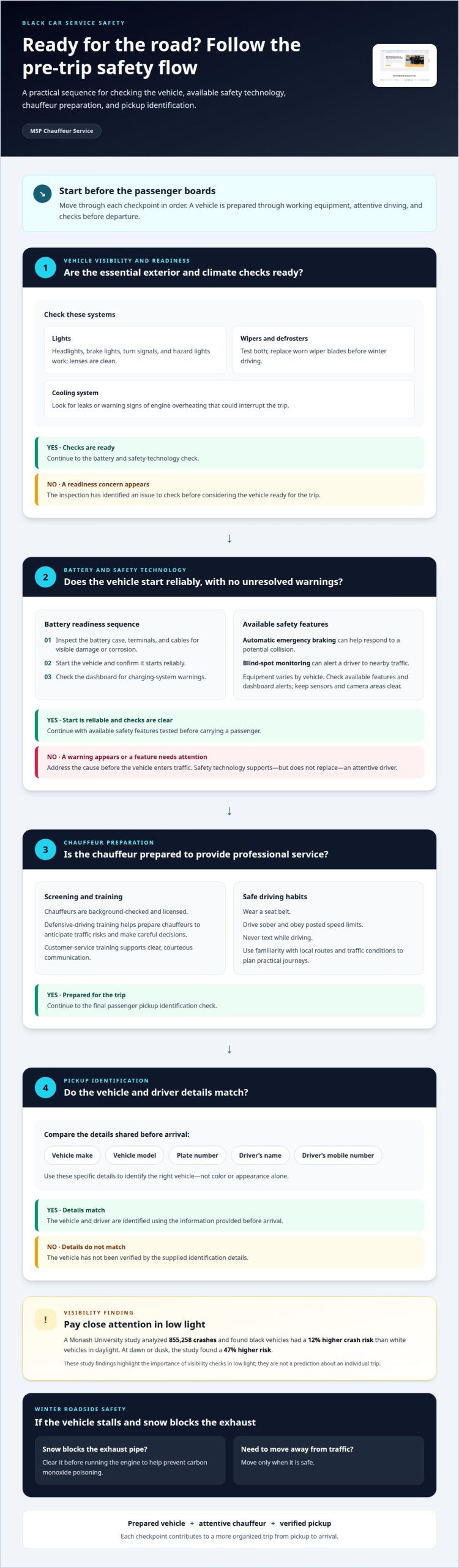
Before a trip, we check headlights, brake lights, turn signals, and hazard lights. Our chauffeurs keep light lenses clean and confirm each light works, helping the vehicle stay visible in changing conditions. We also test windshield wipers and defrosters, replacing worn blades before winter driving. A cooling-system inspection can reveal leaks or warning signs of engine overheating that could interrupt your trip. These checks make vehicle readiness a practical part of safe service.
We make pickup identification straightforward by sharing the vehicle’s make, model, and plate number, along with the driver’s name and mobile number, before arrival. When your car arrives, compare those details before boarding. This lets you identify the right vehicle using specific information, not color or appearance alone.
Black paint itself does not determine whether a vehicle is safe. A Monash University study analyzed 855,258 crashes and found black vehicles had a 12% higher crash risk than white vehicles in daylight. At dawn or dusk, the study found a 47% higher risk for black vehicles than white vehicles. We treat these findings as a reason to pay close attention to visibility checks in low light, not as a prediction about your individual trip.
If your vehicle stalls in winter, safety comes first. If snow blocks the exhaust pipe, clear it before running the engine to help prevent carbon monoxide poisoning. Our chauffeurs keep lights visible and use working wipers and defrosters, and move away from traffic only when it’s safe.
Commercial auto liability coverage and limits depend on the jurisdiction and policy terms. There is no single typical limit for every black car service, so we don’t suggest one universal figure.
For COVID-19 and other infectious diseases, routine cleaning and sanitization between passenger trips are practical precautions. We treat a clean vehicle as part of a comfortable, considerate ride.
2. Checking batteries and safety technologies
A dependable start begins with a battery check. Before service, we inspect the battery case, terminals, and cables for visible damage or corrosion. We confirm that the engine starts reliably and check the dashboard for charging-system warnings. A weak battery can prevent a vehicle from starting or powering essential systems. In cold weather, that can disrupt your pickup and delay your trip. Battery condition, secure connections, and warning lights all matter.
Next, we confirm that the vehicle’s available safety technologies work as intended. Automatic emergency braking can help respond to a potential collision, while blind-spot monitoring can alert a driver to nearby traffic. These features support attentive driving but don’t replace it. Some black cars may also have collision-avoidance systems or passenger-monitoring capabilities. Since equipment varies by vehicle, we consider the features present and check for dashboard alerts before departure.
Black car, taxi, and rideshare safety standards aren’t one universal checklist. Requirements and practices can vary by service category and location. We focus on practical essentials for your trip: working safety equipment and careful driving.
Black car services in the United States must comply with federal, state, and local laws, including commercial transportation licensing and permit requirements. The applicable rules depend on where and how the service operates; for instance, premier private transport providers in other destinations, such as luxortrans.com in Hawaii, adhere to their own distinct regional standards and permitting. Requirements for one service category shouldn’t be assumed to apply identically to another.
Our readiness sequence is straightforward: inspect the battery, start the vehicle, check for warning indicators, then test available safety features before carrying a passenger. If a warning appears, we address the cause before the vehicle enters traffic. We also keep sensors and camera areas clear of dirt and obstructions, which may affect performance. These checks make safety technology a useful layer of support alongside an alert driver and a prepared vehicle. The systems support, rather than replace, attentive driving.
3. Driver background screening and training
A professional ride depends on more than a prepared vehicle. Our chauffeurs are background-checked and licensed, and we treat screening as an important part of passenger service. Screening procedures can vary, so we don’t suggest every company follows the same process. For your trip, driver preparation also includes training, professional conduct, and readiness to make responsible decisions behind the wheel.
We value training in defensive driving and customer service. Defensive-driving instruction helps chauffeurs anticipate traffic risks and make careful decisions. Customer-service training supports clear, courteous communication at pickup and during travel. These skills matter in everyday situations, such as confirming your destination, responding calmly to a route change, and maintaining professional conduct throughout the ride.
Our chauffeurs are expected to follow safe driving habits after training, too. That means wearing a seat belt, driving sober, obeying posted speed limits, and never texting while driving. These actions keep attention on traffic and reduce avoidable distractions. Familiarity with local routes and traffic conditions also helps us plan practical journeys through Minneapolis, St. Paul, and nearby communities.
We understand that passenger privacy matters, especially during corporate travel. Discretion and confidentiality are important in executive transportation. Clear confidentiality expectations can help protect sensitive conversations and trip details. We also provide pickup information, including the driver’s name and contact details, so you can identify your chauffeur without sharing private information publicly.
As you consider driver readiness, look for practices that support:
- Background screening as part of chauffeur safety practices.
- Defensive-driving and customer-service training for professional trips.
- Seat-belt use, sober driving, speed-limit compliance, and no texting behind the wheel.
- Local route familiarity, discretion, and clear passenger communication.
Screening and training serve different purposes: screening informs driver readiness, while training helps shape decisions on the road. For point-to-point travel, our professional conduct matters from pickup through arrival.
4. Emergency response readiness
At MSP Airport Chauffeur Service, we believe a prepared trip includes a plan for breakdowns, collisions, and sudden illness. Before driving, our chauffeur should know how to communicate the vehicle’s location and request assistance. We follow clear steps to help passengers focus on safety instead of guessing what happens next. For example, a mechanical warning may mean stopping in a safe place and arranging help before continuing.
If the driver or vehicle seems unsafe, don’t board or continue the ride. Ask the driver to stop somewhere safe, leave the vehicle if you can do so safely, and contact emergency services if there’s immediate danger. Share your location with someone you trust when practical. Put your safety ahead of comfort or keeping to a schedule.
For a roadside problem, we make getting out of moving traffic the first priority when it’s safe. Our chauffeur should communicate the location, explain the issue, and keep you informed about the next step. In winter, poor visibility or a blocked roadway can change what’s safest, so our driver should avoid directing you into traffic or hazardous conditions. We resume travel only when the vehicle and route are safe.
A medical emergency calls for a different response. Our driver should stop safely, contact emergency services when needed, and give responders the vehicle’s location. You can help by describing the situation clearly and following emergency personnel’s instructions. After a collision, avoid standing near traffic, and don’t move an injured person unless there’s immediate danger.
Before your trip, keep our dispatch contact handy and make sure someone knows your route and estimated arrival time. If plans change, share the new destination and pickup details through the appropriate contact channel. This creates a simple record of your expected route without relying on memory during a stressful event.
- Move away from traffic only when it is safe.
- Share the precise location when requesting help.
- Contact emergency services for immediate danger or urgent medical needs.
- Keep passengers updated before travel resumes.
For planned Twin Cities travel, arrange a point-to-point ride with your trip details ready.
MSP Airport Chauffeur Service: MSP BLACK CAR SERVICE TO MAYO CLINIC Rochester mn
MSP Airport Chauffeur Service offers a practical option for travel between MSP Airport and Mayo Clinic in Rochester. A prearranged ride can simplify the longer journey, whether you’re traveling for an appointment or returning to the Twin Cities.
For Minneapolis trips, choose MSP CHAUFFEUR SERVICE MINNEAPOLIS or a MINNEAPOLIS Luxury Sedan. Corporate travelers can book corporate chauffeur service and arrange trip details around their itinerary. Share your pickup location, destination, and travel timing when you reserve so the ride can be planned around your needs.
Safety readiness matters throughout the trip, from pickup identification to communication when plans change. Choose the service that fits your route, and keep your reservation details handy on travel day.
Contact MSP Airport Chauffeur Service to discuss your ride.
Plan your next ride with confidence
Start planning your next trip with what matters most: a clear pickup, a suitable route, and reliable communication. Keep your reservation details together, note any timing or destination needs, and make sure everyone traveling knows where to meet. A clear meeting point helps all riders. These small steps turn black car service safety protocols into practical expectations for your ride.
For Twin Cities airport, business, or personal travel, choose the ride type that fits your journey and share essential details when booking. MSP Airport Chauffeur Service can support Minneapolis trips, corporate itineraries, and longer journeys to Mayo Clinic. Think ahead about luggage, pickup access, and companions who need the same instructions. A concise plan gives your trip a clear starting point and leaves fewer details to resolve on travel day.
Contact MSP Airport Chauffeur Service to discuss your upcoming trip. A little planning now can help you set out feeling prepared and at ease.
Frequently Asked Questions
What safety protocols do black car services follow for vehicle maintenance and inspections?
Common measures include regular mechanical inspections, current registration and insurance, and routine vehicle cleaning. Inspection records help a service track maintenance and address developing problems before they interrupt a trip. For a Minneapolis airport pickup, cleanliness and readiness both matter: the vehicle should be prepared for passengers, not simply waiting at the curb. Inspection practices and schedules can vary.
How do black car services screen, train, and monitor drivers?
Passenger security measures can include background screening, defensive-driving and customer-service training, and GPS tracking. Each serves a different purpose: screening considers a driver’s background, training prepares them for driving and passenger interactions, and GPS can support trip monitoring. These measures are part of our professional chauffeur service, including airport and corporate travel.
What background checks and licensing are required for black car service drivers in the United States?
Requirements depend on applicable federal, state, and local rules, as well as the type of commercial transportation service. Commercial transportation licensing and permits may apply, but there is no single set of requirements for every US location. In Minnesota, requirements depend on the service’s operating area and classification, rather than rules in another city, just as regional operators such as macarthurairportcarservice.com align with local transportation authorities across New York airports.
What passenger safety procedures do black car services use for pickups, drop-offs, and trips?
Passenger procedures can include clear boarding and exiting instructions, luggage-handling guidance, estimated arrival times, and a contact option for trip updates. At an MSP Airport pickup, clear instructions help passengers find the agreed meeting point and board without confusion. During the ride, updates about route or timing changes can keep everyone informed, especially when the trip includes a scheduled appointment or connection.
What vehicle safety features should passengers look for in a black car service?
Automatic emergency braking and blind-spot monitoring can support a driver’s awareness and response. GPS equipment can also support trip monitoring. Features vary by vehicle, so consider whether the selected car has the capabilities needed for your journey. These systems are aids, not substitutes for attentive driving or sound vehicle maintenance.
How can passengers verify a black car service vehicle and driver before getting in?
Before pickup, use your trip details to match the vehicle’s make, model, and plate, and confirm the driver’s name. If any detail differs, pause before boarding and contact us through the established contact channel. At a busy location such as MSP Airport, checking the full vehicle details is more reliable than approaching a car based only on its color or appearance.