Airport transportation safety standards cover more than a vehicle’s condition: they also involve maintenance practices and airport safety programs. The FAA Airport Safety Program covers general aviation airport safety, runway safety, Part 139-certificated airports, and airport safety management systems. Together, these areas help us explain how vehicle checks fit into the wider safety picture.
It’s reasonable to expect a safe airport ride to begin with a well-maintained vehicle. But airport safety programs and regulations have different scopes, and they do not all apply to passenger vehicles in the same way. Here’s what vehicle features and inspections can tell you, what the FAA’s airport safety program covers, and how airport rules shape transportation operations. You’ll have a clearer way to assess airport transportation safety standards and choose a ride for travel in Minneapolis, Saint Paul, and across Minnesota.
Key Takeaways
- Use a consistent vehicle-check routine to spot maintenance concerns before an airport trip, not just at departure.
- Separate airport-wide safety programs from the checks and requirements that apply to ground transportation vehicles.
- Understand how federal airport guidance and local operating rules can cover different parts of airport safety.
- Match your transportation choice to the trip, then review the vehicle and service details that support a smooth pickup.
Vehicle safety features and maintenance inspections
Common risks include worn tires, poor visibility, brake problems, and confusing curbside traffic. Before boarding, look for obvious vehicle issues, fasten your seat belt, and follow pickup-area instructions.
Vehicle condition and safe movement around the airport both matter. Knowing what to look for, how to check the vehicle, and how to move safely near airport roadways can help reduce avoidable risks.
Vehicle Safety Features
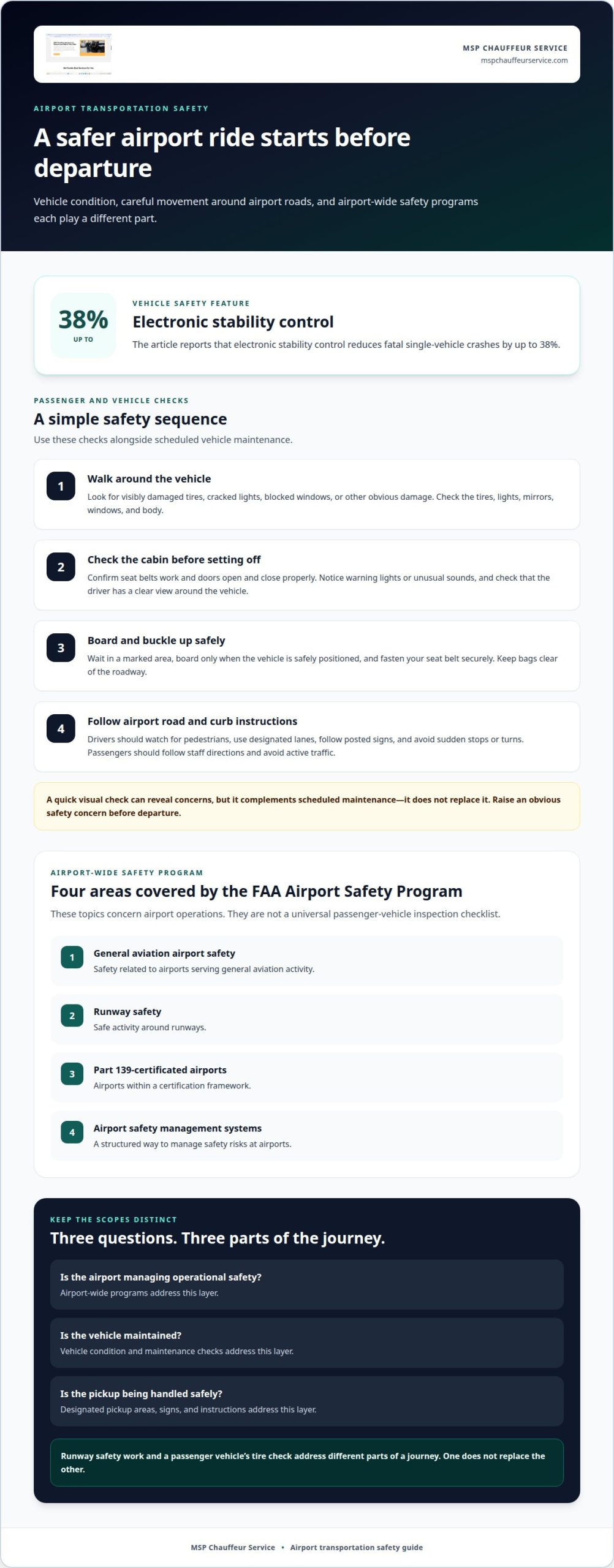
Look for working seat belts, clear mirrors, effective lights, and safety systems such as electronic stability control. These features support vehicle control and visibility when traffic or road conditions change. Electronic stability control reduces fatal single-vehicle crashes by up to 38%. We suggest confirming your seat belt fastens securely and checking that the driver has a clear view around the vehicle before departure.
Maintenance Inspections
A quick walk-around can help spot visible issues before a trip. Check the tires, lights, mirrors, windows, and body for damage. Inside, make sure seat belts work and doors open and close properly. Notice any warning lights or unusual sounds before setting off. These observations complement scheduled maintenance, but do not replace it.
Safe movement on airport roads and at curbs matters, too. Drivers should watch for pedestrians, follow posted signs, use designated lanes, and avoid sudden stops or turns. Passengers can help by waiting in marked areas and boarding only when the vehicle is safely positioned. Keep bags clear of the roadway.
- Before boarding, look for visibly damaged tires, cracked lights, or blocked windows.
- Once seated, fasten your belt and keep it secured during the trip.
- At the airport curb, follow staff directions and avoid stepping into active traffic.
If you notice an obvious safety concern, raise it before departure. Vehicle features, regular maintenance, and careful driving all contribute to a safer airport journey.
Airport safety program scope
The FAA Airport Safety Program covers several airport-wide areas, not just passenger vehicles. According to the FAA, its scope includes general aviation airport safety, runway safety, Part 139-certificated airports, and airport safety management systems. We can use those areas to understand which parts of airport operations the program addresses.
These areas address different parts of airport operation. General aviation airport safety concerns airports serving general aviation activity. Runway safety focuses on safe activity around runways. Part 139-certificated airports fall within a certification framework. Airport safety management systems provide a structured way to manage safety risks at airports. We can keep these subjects distinct when considering a passenger trip.
The distinction matters because airport operations and ground transportation are related but separate. A program focused on runway safety does not describe every inspection required for a shuttle, taxi, or private car. For instance, runway safety work and a passenger vehicle’s tire check address different parts of a journey. They are not interchangeable checks.
Passengers can consider three separate questions: Is the airport managing operational safety? Is the vehicle maintained? Is the pickup being handled safely? The FAA program’s scope helps explain the first. Vehicle inspections and curbside procedures address the other two. This distinction clarifies the limits of airport transportation safety standards: they are not one single checklist.
- For airport-wide scope, identify whether the topic concerns general aviation, runways, Part 139 certification, or a safety management system.
- For the vehicle, consider its condition and maintenance checks separately.
- For pickup safety, follow signs and instructions in the designated ground transportation area.
At MSP Airport, this distinction helps clarify what an airport safety program covers and what it leaves outside its scope. The FAA program’s four areas provide a useful overview of airport-level safety work, but they do not replace attention to the vehicle or pickup. Consider each safety claim in context, then follow the steps relevant to your trip.
Airport safety regulations and guidance
Federal guidance addresses airport certification and safety management, while ground transportation rules can vary by airport. Keep airport operations, vehicle requirements, and passenger access rules separate.
Standards Across Transportation Types
Taxis, rideshares, shuttles, buses, and public transit don’t share one universal airport vehicle checklist. The applicable rules depend on the service and airport. The FAA identifies 14 CFR Part 139 as the regulation for airport certification. That certification framework concerns airports, not a single set of vehicle checks covering every transportation type.
According to the FAA, Order 5280.5 is the Airport Certification Program Handbook, and Order 5200.11 is its Airports Safety Management System order. The Airport Safety Management System final rule appeared in the Federal Register on February 23, 2023, as 88 FR 11642. These references help distinguish airport-level oversight from operator or vehicle requirements.
Forms also address specific airport functions. The FAA lists Form 5280-1 as the application for an Airport Operating Certificate. FAA Form 5200-7 is used by pilots, airports, and others to report bird and animal strikes. The FAA’s NEPA notice on airport wildlife hazard management plans is 81 FR 72145, dated October 13, 2016. These documents concern certification, reporting, or wildlife review, rather than identical rules for every ride type.
Security Requirements for Operators and Drivers
The FAA guidance concerns airport safety and certification; it does not establish TSA-specific requirements for ground transportation drivers or operators. TSA security requirements and airport certification rules are separate. Follow airport security instructions independently of the ground transportation pickup process.
When traveling between terminals, parking lots, and rental car facilities, follow posted directions and use designated pickup or boarding areas. Airport-specific access and curb rules determine where vehicles may load or wait. At MSP Airport, read the signs for your destination, stay in marked pedestrian areas, and board at the assigned location. Terminal directions are separate from federal airport certification guidance.
What safety standards apply to airport shuttles, buses, taxis, and rideshare vehicles?
Safety expectations depend on the vehicle, service model, and airport rules. In Minneapolis, consider the vehicle’s condition, the driver’s professional role, and the pickup procedure instead of assuming every ride follows the same standard.
Safety can vary between commercial shuttle services and private passenger vehicles. Reported rates are 0.11 deaths per 100 million passenger miles for professional shuttle service, compared with 1.11-1.26 deaths per 100 million passenger miles for private passenger vehicles. These figures describe broad categories, not a guarantee for an individual trip.
Professional livery drivers have 33% fewer crashes than general motorists. That comparison can help frame the role of professional driving, but it doesn’t establish identical requirements for taxis, rideshares, shuttles, buses, or public transit. Services differ in how trips are arranged, how passengers board, and which airport operating rules apply.
Use these practical checks across transportation types:
- Taxi or rideshare: Confirm the vehicle and driver match the booking details before entering.
- Shuttle or bus: Use the marked stop, board carefully, and follow posted passenger instructions.
- Public transit: Follow station signs and keep clear of vehicle lanes while waiting.
- Any ride: Fasten the available seat belt and report an obvious vehicle concern before departure.
Airport transportation safety standards also depend on the pickup setting. A shuttle boarding at a designated stop involves different passenger movements from a taxi pickup at the curb. At MSP Airport, wait in the assigned pickup area and avoid approaching vehicles in active traffic lanes. Clear identification, orderly boarding, and attention to the vehicle’s condition help you make a practical safety assessment.
Choose the service type that fits your route and group, then follow its airport pickup instructions. For a reserved airport transfer in Minneapolis, book an MSP airport executive service.
MSP Airport Chauffeur Service: MSP CHAUFFEUR SERVICE MINNEAPOLIS
MSP Airport Chauffeur Service offers reliable airport transportation safety standards for travelers who want a prearranged ride to or from MSP Airport. Choose point-to-point transportation for a direct trip, a Minneapolis luxury sedan for individual travel, or corporate chauffeur service for business journeys.
A reserved ride can simplify the transportation part of your travel plan while adhering to strict airport transportation safety standards. Set your pickup and destination, then follow airport signs to meet your vehicle. A dedicated chauffeur ride may suit an early departure, business travel, or a trip when you prefer a private vehicle over shared transportation.
For a Minneapolis airport transfer or point-to-point ride meeting top airport transportation safety standards, book with MSP Airport Chauffeur Service at mspchauffeurservice.com.
Plan a More Confident Airport Pickup
Before booking your next airport ride, decide what matters most: your pickup location, destination, and the type of trip you have planned. Keep your reservation details handy and follow airport signs when meeting your ride. Clear plans turn airport transportation safety standards into practical choices for your journey.
For travel to or from MSP Airport, choose transportation that fits your schedule and trip. MSP Chauffeur Service offers chauffeur, luxury sedan, and corporate travel options in Minneapolis. Share your pickup and destination details when booking to make the plan clear.
Ready to plan your next Twin Cities airport trip? Contact MSP Airport Chauffeur Service and take the next step toward a well-organized travel day.
Frequently Asked Questions
What federal agencies regulate airport ground transportation safety in the United States?
For airport certification and airport safety programs, the FAA is the federal agency identified here. Its references include 14 CFR Part 139, Order 5280.5, and Order 5200.11. These address airport certification and airport safety management, rather than setting one rulebook for every taxi, rideshare, shuttle, or transit ride. Treat airport operations and transportation-provider obligations as separate regulatory questions.
What driver licensing, training, background check, and drug testing rules apply to airport transportation?
Airport certification guidance alone does not establish one licensing, training, background-check, or drug-testing rule for every ground transportation driver. MSP Chauffeur Service’s chauffeurs are licensed, background-checked, insured, and trained in MSP Airport operations. These provider practices are distinct from legal duties, which depend on transportation category and jurisdiction.
What vehicle inspection, maintenance, accessibility, and insurance requirements apply to airport transportation providers?
Requirements depend on jurisdiction and vehicle or service category, so do not assume one airport’s rules apply nationwide. MSP Chauffeur Service vehicles are insured and regularly inspected. Consider vehicle condition, insurance coverage, and boarding access as separate factors when planning a trip. Match the boarding arrangement to your mobility needs and intended transportation.
What airport permits, fees, and operating rules apply to commercial ground transportation providers?
Airport authorization, loading locations, staging procedures, and administrative charges can vary. Each airport’s ground transportation rules determine which processes apply to commercial vehicles on its property. For an MSP pickup, follow airport signs and use the designated transportation area. Do not assume another airport’s permits, curb rules, or charges apply at MSP.
How do airport ground transportation safety rules vary by state, city, and individual airport?
State and local requirements can govern transportation services, while individual airports manage access and pickups on their property. A rule for one city or airport does not automatically apply elsewhere. For Minnesota travel, distinguish the vehicle service’s applicable operating requirements from the airport’s pickup instructions. This helps you follow the procedures for your trip and location.